
Civil Defence and Societal Resilience – Lessons from Russia’s War of Aggression and the Nordic-Baltic States
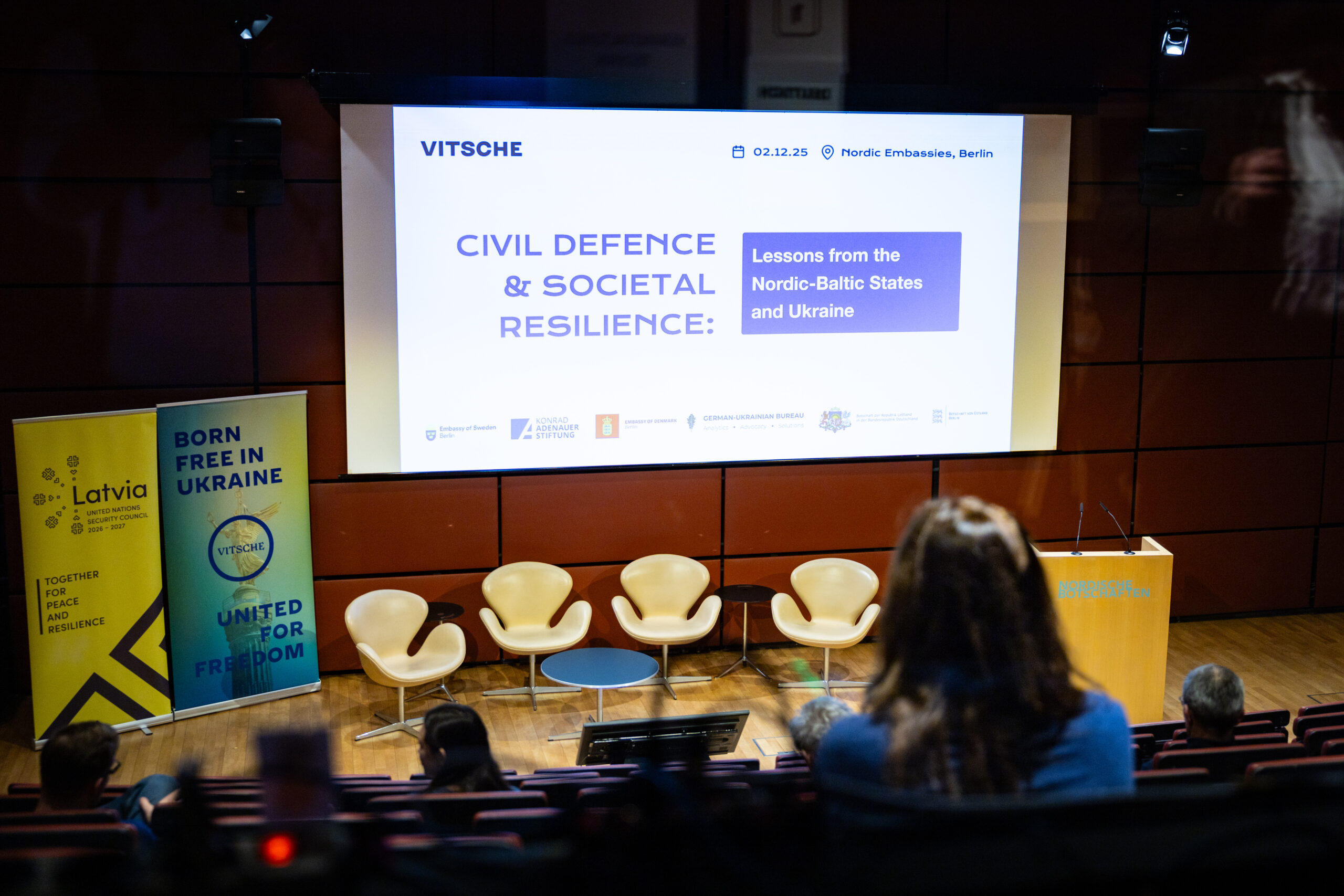
Public Discussion & Parliamentary Briefing | Berlin, 2 December 2025
Europe is no longer asking whether its security order is under pressure, but how societies can hold together against persisting threats. At the Nordic Embassies in Berlin, experts from the Nordic-Baltic states, Ukraine and Germany came together to discuss the following question: what can Europe, and Germany in particular, learn about total defence, resilience and democratic stability from the Nordic-Baltic region and Ukraine, which is at war? The discussion focused not on abstract concepts, but on how states, cities and communities and individuals stay functional when pressure is real and the risks are no longer abstract.
Iryna Shulikina, CEO of Vitsche “Across all viewpoints, one message stood out: Europe’s security depends on societies that are informed, prepared, connected and capable of acting together.”
More than 100 guests, among them policymakers, researchers, diplomats, volunteers, and journalists attended the event.Russia’s war against Ukraine has shown that modern conflict spreads far beyond the battlefield. It hits digital communication, public trust, and the cohesion that keeps democracies steady. Several speakers warned that Germany, as the EU’s largest state, is both an obvious target and a central pillar for Europe’s stability.
Inna Nelles, moderator, Co-Founder of the German-Ukrainian Bureau (DUB) quotes Silke Willems “We are witnessing a sharp escalation of the situation in Germany. We are facing cyber attacks, sanctions evasion, arson – all of these on a scale we have never seen before.”
The Nordic-Baltic states have spent decades building models that treat every citizen, every company, and every institution as part of national resilience. These countries showcase clear chains of responsibility, well-rehearsed emergency plans, and strong cooperation between public and private actors.
Dr. Pekka Kallioniemi, researcher on disinformation and social media “In the Finnish comprehensive system, everybody knows what they have to do in case of a crisis. Everybody plays a role, and everybody should know their role. This is what is called comprehensive defense or comprehensive preparedness in Finland. It’s a whole-of-society approach to crisis management.”
Any discussion of total defence in the European context is incomplete without Ukraine. Its experience combining state institutions, volunteer networks, small businesses and adaptive local communities provides key insights for enhancing resilience and defence throughout the European Union.
Dr. Oksana Huss, University of Duisburg-Essen “Resilience is what we talk about after everything has already gone wrong. Before that, we have to talk politically – about fighting Russia where it is now – with sanctions and with the weapons Ukraine needs to deter further aggression.”
This perspective reframes resilience as a last line of defence once political choices have failed. It underlines that if Europe takes current challenges seriously, it must take prevention seriously: sustained sanctions, military support for Ukraine, and clear political will to stop Russian aggression before societies are forced to endure the consequences.
Germany already recognises the need to rethink its approach to civil and societal resilience. What it now faces is a practical challenge.
Throughout the discussion, several recurring needs emerged:
- Clear leadership and responsibility across federal, state, and municipal levels.
- Stronger cooperation between government, business, and civil society.
- Crisis communication that earns and keeps public trust.
- Volunteer networks that are trained, equipped, and integrated into official planning.
- Investment in infrastructure that remains functional under hybrid and physical stress.
Johannes Steger, security policy and resilience expert “Germany urgently needs a strategic communication approach that goes where the people are… Before we talk about how we speak about crises, we need to actually talk about them – and about why it’s important to be aware of these things.”
The challenge ahead is not simply protecting infrastructure. It is protecting the democratic and social fabric that holds countries together.
Sigita Struberga, Secretary-General, Latvian Transatlantic Organisation “We started in 2014, and it was far too late. Unfortunately for Latvians, as for other Europeans, 2008 was not a wake-up call.”
This requires long-term political will, coordination across ministries, and a hegemony that treats resilience as a shared responsibility. The Nordic-Baltic states showed what is possible. Now, the task is to make these insights part of Germany’s next chapter of a real “Zeitenwende”.To support this work beyond a single event, we want to highlight key publications that map the threat landscape and offer practical models for total defence.
These include:
The joint Konrad-Adenauer-Stiftung / Stockholm Free World Forum study Russia’s Hybrid War: The Northern Front, which documents everyday hybrid intimidation and sabotage across the Nordic-Baltic region
Swedish Civil Contingencies Agency brochure In case of crisis or war – Important information to all residents of Sweden, which shows how total defence can be communicated in concrete terms to every household.
Further work on Germany’s preparedness debate includes Deutschland im Ernstfall by Johannes Steger and Ferdinand Gehringer.
Oksana Huss’s research on societal resilience and internal displacement in Ukraine can be found in her article “Polycentric crisis response and societal resilience…”
Practical guidance for households is also available in Latvia’s national 72 stundas preparedness plan, which sets out how citizens can cope independently during the first three days of a crisis. Sigita Struberga also underlined: “We began with the idea of a ‘72-hour backpack’. Later we realized that’s a bad narrative. A backpack means you grab and run. The idea is not to grab and run – the idea is to stay, be resilient, and in the best case, resist.”
Contributions came from:
- Sigita Struberga, Secretary-General, Latvian Transatlantic Organisation
- Dr. Oksana Huss, University of Duisburg-Essen
- Johannes Steger, security policy and resilience expert
- Dr. Pekka Kallioniemi, researcher on disinformation and social media (online)
Moderation by Inna Nelles, Co-Founder of the German-Ukrainian Bureau (DUB).
The event was organised by Vitsche e.V. and the German-Ukrainian Bureau (DUB) in partnership with: Konrad-Adenauer-Stiftung (KAS); Embassy of Denmark; Embassy of Latvia; Embassy of Estonia; Embassy of Sweden