

Wie unterstützt russland die AfD, um die deutsche Demokratie zu bedrohen?
Viele Ereignisse, Fotos und Fakten zeigten Verbindungen zwischen russland und rechtsextremen Bewegungen in Europa. Die AfD ist eines der prominentesten Beispiele dafür. Der größte Beweis dafür ist ihre anhaltende Unterstützung der russischen Politik und ihre innerstaatlichen Aktivitäten, um das gesamte Konzept der europäischen Demokratien zu untergraben.
russlands nichtlineare Kriegsführung geht über Panzer und Raketen hinaus. Mit Trollfabriken, die deutsche Medien und Öffentlichkeit beeinflussen, Propagandazentralen wie das russische Haus im Herzen von Berlin und durch den Aufbau von Kontakten und engen Beziehungen zu extremen politischen Parteien wie der AfD versucht die russische Regierung, Staaten und Gesellschaften zu destabilisieren.
Eine direkte Bedrohung geht von der AfD aus, die trotz des russischen Angriffskriegs gegen die Ukraine und zahlreicher Drohungen der russischen Regierung gegenüber Deutschland und anderen demokratischen europäischen Staaten ihre außenpolitische Ausrichtung auf russland beibehält. Viele Recherchen bestätigen die provokanten Reisen von AfD-Politikern in die von russland besetzten Gebiete der Ukraine, ihre pro-russischen Anträge im Bundestag und gemeinsame Ideologien und Sprachnutzung.
Bereits vor der russischen Großinvasion legitimierte die AfD die Annexion der Krym, und AfD-Abgeordnete unternahmen sowohl private als auch diplomatische Reisen zu russischen Propagandaveranstaltungen (wie Waldemar Herdt, Frank Pasemann und Udo Hemmelgarn beim “Yalta International Economic Forum” 2019). Während ihres Aufenthalts kritisierten sie offen die europäische Demokratie und sprachen von einer “Diktatur aus Brüssel”.
Seit Beginn der umfassenden russischen Invasion in die Ukraine hat die AfD ihre Herangehensweise an russland kaum verändert:
- AfD-Vertreter setzen ihre Reisen nach russland fort.
- Die Partei hat einen pro-russischen Friedensplan vorgelegt und ein pro-russisches Programm für die bevorstehenden EU-Wahlen verabschiedet.
- Der bayerische Landesverband der Partei lehnt sogar die Lieferung deutscher Waffen an die Ukraine ab, fordert die Einstellung der Ausbildung ukrainischer Soldaten in Bayern und die Aufhebung von Sanktionen gegen russland.
- Anstatt die Rolle russlands und die Verantwortung für den Krieg in der Ukraine anzuerkennen, schiebt die AfD die Schuld auf die USA.
Laut einer aktuellen Studie von Spiegel und The Insider soll ein Mitarbeiter des AfD-Bundestagsabgeordneten Eugen Schmidt enge Verbindungen zu einem Oberst des russischen Inlandsgeheimdiensts FSB unterhalten haben. Der 52-jährige Wladimir Sergijenko soll in engem Kontakt mit dem russischen Geheimdienstoberst Ilja Wetschtomow gestanden und finanzielle Unterstützung aus russland erhalten haben.
Es lohnt sich auch, die mögliche Beteiligung des russischen Hauses in Berlin und seines Betreibers Rossotrudichestvo an dem Netzwerk in Betracht zu ziehen, das russische Agenten in Deutschland mit AfD-Vertretern verbinden könnte. Weitere Informationen dazu findet ihr in der Datenbank und Recherche über das russische Haus von Vitsche und OSINT FOR UKRAINE: https://exposingrushouse.com/.
In den letzten Wochen haben wir beeindruckende Demonstrationen gegen Rechtsextremismus in ganz Deutschland erlebt. Hunderttausende Menschen sind in vielen Städten auf die Straße gegangen, um sich für Vielfalt und Demokratie einzusetzen und gegen Rassismus und Rechtsextremismus zu protestieren.
Diese Proteste haben gezeigt, dass die deutsche Gesellschaft die Bedrohung der Demokratie durch die AfD erkennt. Jetzt ist es auch an der Zeit, ihr Netzwerk und Ausmaß anzuerkennen. Wir müssen uns vereinen, denn die Feinde der Demokratie sind vereint, wie wir es bei russland und der AfD sehen.
Wir laden alle ein, die gegen Rechtsextremismus, Autokratie, Unterdrückung und Aggression sind, sich unserer großen Demonstration am 24. Februar am Brandenburger Tor anzuschließen. Teilt den Aufruf, kommt zahlreich und zeigt gemeinsam mit dem ukrainischen Volk eure Solidarität.

Berlin, 06.01.2024 – Der deutsch-ukrainische Verein Vitsche organisierte heute vor dem Kanzleramt einen Protest mit ca. 1000 Teilnehmenden und richtete sich an die Bundesregierung und ganz besonders an den deutschen Kanzler Olaf Scholz.
“Deutschland und viele NATO-Länder verfügen über die notwendigen Ressourcen, um die Ukraine ausreichend zu unterstützen, damit sie russland besiegen kann. Doch der Wille, dies schnell und tatkräftig zu tun, fehlt leider nach wie vor. Wir appellieren an die Bundesregierung, Taurus an die Ukraine zu liefern und die Bereitstellung von Munition auszubauen. Dies sollte nicht nur aufgrund historischer Verantwortung gegenüber der Ukraine geschehen, sondern auch im Interesse der Sicherheit der eigenen Bürger*innen. Andernfalls könnten Deutsche in wenigen Jahren gezwungen sein, sich selbst gegen russische Bedrohungen zu verteidigen.”, so Krista-Marija Läbe, Pressesprecherin von Vitsche.
Unsere Forderungen:
1. Ausweitung und Beschleunigung der Produktion und Lieferung von zusätzlichen Luftabwehrsystemen und Munition an die Ukraine.
2. Bereitstellung von Kampfdrohnen aller Art für die Ukraine.
3. Versorgung der Ukraine mit Langstreckenraketen mit einer Reichweite von über 300 km, wie etwa den Taurus Marschflugkörpern.
4. Genehmigung der Verwendung eingefrorener russischer Vermögenswerte zur Unterstützung der Ukraine.
5. Ausweitung von Sanktionen gegen Russland und Schließung von Schlupflöchern.
6. Isolierung der russischen Diplomaten in Deutschland.
Als Antwort auf die aktuelle Angriffswelle russlands auf die Ukraine organisieren Gruppen der Zivilgesellschaft in ganz Europa und in vielen Städten in Deutschland Proteste, um die Ausweitung der Ukraine-Unterstützung von ihren Regierungen zu fordern.
Wir bedanken uns bei allen Sprecher*innen und Teilnehmenden, die heute bei unserem Protest in Berlin dabei waren.
Bitte berichten Sie über die Aktion in Ihren Kanälen. Die Ukraine braucht die öffentliche Aufmerksamkeit dringend, um überlebenswichtige langanhaltende Unterstützung zu bekommen. Helfen Sie dabei und geben Sie Ukrainer*innen eine Stimme!
Kontakt: press@vitsche.org
Das neue Jahr 2024 beginnt in der Ukraine so, wie das Jahr 2023 endete: mit täglichen russischen Massenangriffen auf die zivile Infrastruktur der Ukraine, die viele Tote und Verletzte fordern. Seit dem 31. Dezember haben die russen bereits 170 “Shahed”-Drohnen und Dutzende von Raketen verschiedener Typen abgefeuert. Allein heute starben dabei vier Menschen bei den Angriffen auf Kyiv und Charkiw, und über 90 Personen wurden verletzt. Diese neueste Angriffswelle dauert bereits seit dem 29. Dezember an und betrifft Städte in der gesamten Ukraine. Während der Rest der Welt das neue Jahr feiert, kämpfen die Menschen in der Ukraine weiter um ihr Überleben. Im Angesicht dieses Terrors appellieren wir an die deutsche Regierung, die Unterstützung für die Ukraine auszuweiten, und rufen zu einer Demonstration am 06. Januar 2024 um 14 Uhr vor dem Kanzleramt in Berlin auf.
Unsere Forderungen:
1. Ausweitung und Beschleunigung der Produktion und Lieferung von zusätzlichen Luftabwehrsystemen und Munition an die Ukraine.
2. Bereitstellung von Kampfdrohnen aller Art für die Ukraine.
3. Versorgung der Ukraine mit Langstreckenraketen mit einer Reichweite von über 300 km, wie etwa den Taurus Marschflugkörpern.
4. Genehmigung der Verwendung eingefrorener russischer Vermögenswerte zur Unterstützung der Ukraine.
5. Ausweitung von Sanktionen gegen russland und Schließung von Schlupflöchern.
6. Isolierung der russischen Diplomaten in Deutschland.
Vitsche-Mitglied Sofia Pryduvalova berichtet aus Kyiv, warum diese Hilfe so notwendig ist:
“Ich wachte vom Geräusch der Explosionen auf. Ich dachte, meine Fenster würden zerspringen, weil sie so sehr zitterten. Dann hörte ich die Sirenen der Rettungsdienste, merkte, dass einige Menschen von einer der Raketen getroffen wurden. Ich versteckte mich wieder und hörte weitere Explosionen. Es war beängstigend, und es dauerte fast 3 Stunden am Stück. Ich fühle mit allen Menschen in Kyiv und Charkiw, die heute Opfer dieses schrecklichen Angriffs wurden. Ich bin froh, dass ich noch lebe, aber es bleibt eine Lotterie, denn ich kann nie wissen, wie es beim nächsten Angriff sein wird. Der heutige Angriff zeigt einmal mehr, wie die russen gezielt Wohngebäude angreifen, um noch mehr Leid und Opfer zu verursachen. Da jeder Tag unser letzter sein kann, brauchen wir dringend mehr Hilfe von unseren Partnerländern. Nur so können wir überleben.”
Deshalb bitten wir Sie, kommen Sie zu unserer Demonstration, berichten Sie über die Angriffe und helfen Sie uns, Gehör für diese Forderungen zu bekommen.
Freitag, 15. Dezember 2023, 16:00 – Samstag, 16. Dezember 2023, 5:30 ACUD Kunsthaus, Veteranenstraße 21, 10119 Berlin, Deutschland
Weihnachten ist eine Zeit der neuen Hoffnung, die wie ein heller Stern durch die Dunkelheit der Nacht scheint. Dieses Weihnachten steht der lebendige Geist der Ukraine im ACUD Kunsthaus mit der speziellen Weihnachtsausgabe des Ukrainian Sound Garden: The Birth of Light im Mittelpunkt. Das diesjährige Ereignis, erfüllt von Hoffnung und gemeinschaftlichem Beisammensein, verspricht ein unvergessliches Erlebnis, bei dem traditionelle ukrainische Kultur mit zeitgenössischen künstlerischen Ausdrucksformen verschmilzt.
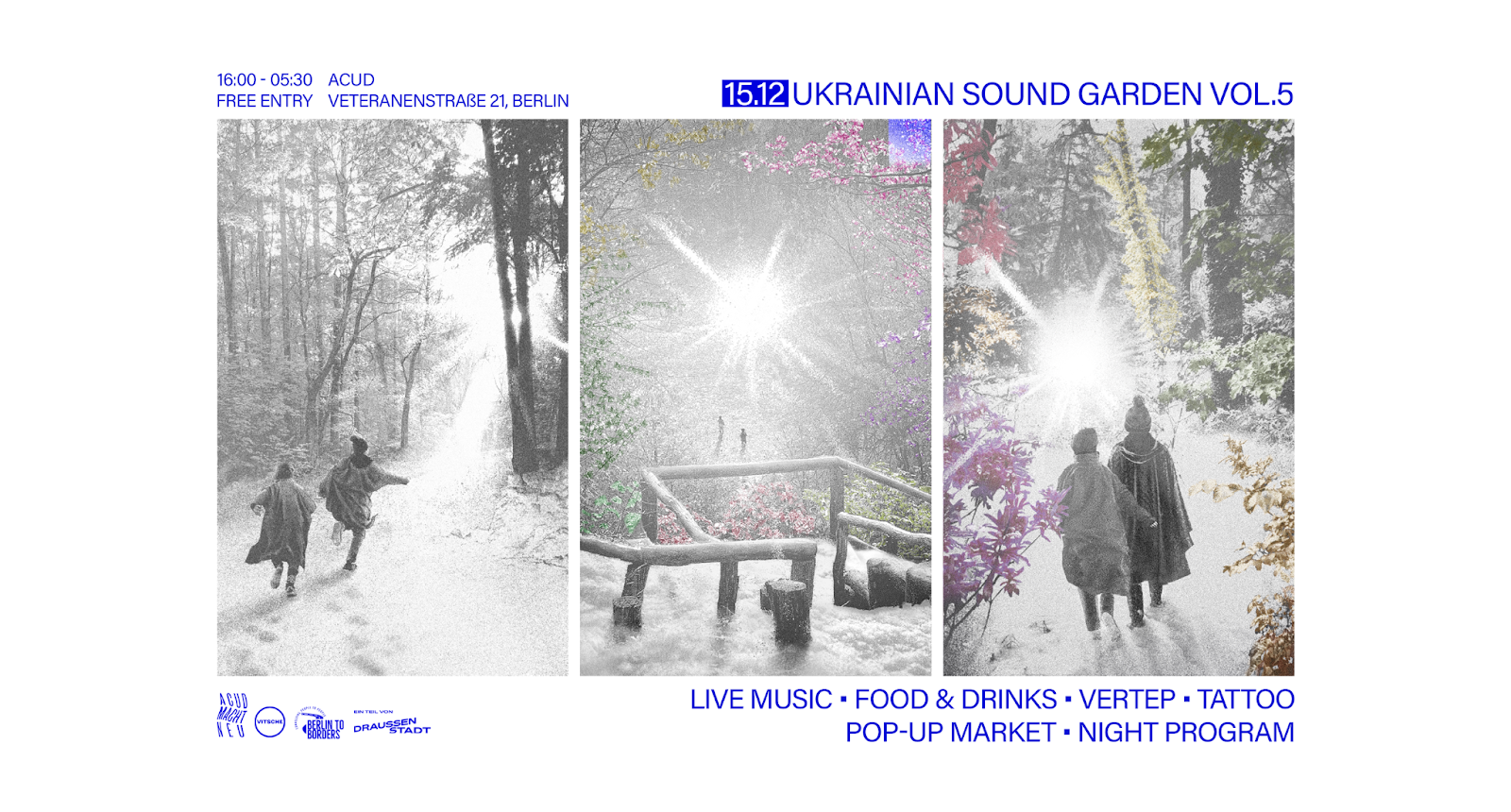
Ukrainian Sound Garden Vol. 5 präsentiert eine kuratierte Mischung aus Live-Auftritten und immersiven Erlebnissen. Das Event wird eine moderne Interpretation der traditionellen ukrainischen Vertep-Aufführung, traditionelle Weihnachtsgerichte aus der Monday Kitchen (“eine Community, in der es alles gibt, außer der Küche”) und einen Pop-up-Markt mit modernen ukrainischen Souvenirs bieten. Kommen Sie am 15. Dezember ins ACUD Kunsthaus, Veteranenstraße 21, 10119 Berlin, Deutschland, von 16:00 Uhr bis in die späten Stunden um 5:30 Uhr am nächsten Tag.


- Zbaraski, ein Musiker und Soundproduzent aus Lwiw, Ukraine. Seine Musik zeigt eine einzigartige Fusion aus Hip-Hop, Pop und elektronischen Genres, gesungen auf Ukrainisch mit einem fesselnden Falsett-Stil.
- GANNA, eine Sängerin und Komponistin aus Berlin. Ganna kombiniert ukrainische Folklore mit Jazz, improvisierter und experimenteller Musik. Heute gilt Ganna als “eine der beeindruckendsten Sängerinnen und Musikerinnen auf der europäischen Jazz- und Weltmusikszene”.
- Komisiia, startete 2018 als Indie-Punk-Band. Heute spielt Komisiia Indie-Pop mit Disco-, Jazz-, Funk- und Latin-Einflüssen.
Um 21 Uhr wird das Team von Vitsche eine traditionelle Weihnachts-Vertep-Performance als Tribut an das historische Ereignis in Lwiw 1971 präsentieren, bei dem führende ukrainische Dichter vom sowjetischen Regime verhaftet wurden, weil sie es aufgeführt hatten.

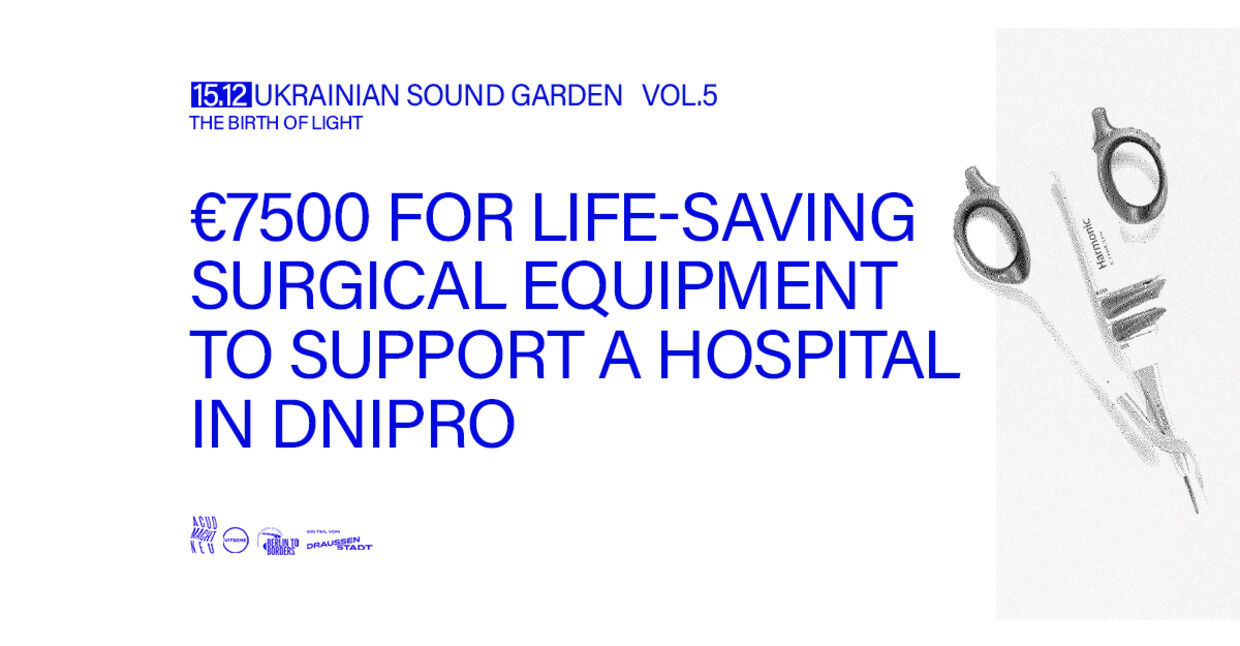
Im Geiste des Gebens zielt Ukrainian Sound Garden Vol 5 darauf ab, 7.500 € zu sammeln, um das Dnipro-Krankenhaus Nr. 16 mit lebensrettender chirurgischer Ausrüstung zu unterstützen. Die Spendenaktion konzentriert sich auf die Beschaffung eines Harmonischen Skalpells, das für komplexe Operationen sowohl bei Militär- als auch bei Zivilpatient*innen, die beim anhaltenden russischen Angriffskreig verletzt worden sind, entscheidend ist.
Dieses Ultraschallgerät, das für verschiedene Operationen wie Laparoskopie und offene Chirurgie unerlässlich ist, bietet zahlreiche Vorteile wie minimalen Blutverlust, reduzierten Kollateralschaden am Gewebe und schnellere Heilungszeiten. Die Anschaffung dieses Geräts wird die Kapazität des Krankenhauses erheblich erhöhen, Patient*innen effizient und effektiv zu behandeln und möglicherweise viele Leben zu retten.
Der Link zum Fundraiser: https://www.betterplace.org/de/projects/130870-life-saving-surgical-equipment-to-support-a-hospital-in-dnipro
Entdecken Sie auf dem Pop-up-Markt, der von 16:00 bis 00:00 Uhr im Studio Acud stattfindet, einzigartige Schätze für Sie und Ihre Liebsten. Erkunde mehr als 10 renommierte ukrainische Marken, darunter RODOVID, ХУІЗИТ und WENECKS, und verpasse nicht das exklusive Vitsche Merch!
Während des Pop-up-Marktes hast du auch die Gelegenheit, dein einzigartiges Weihnachtswesen zu bekommen – unsere Kolleg*innen von Spilka kommen nach Berlin, um ihr Kunst-Atelier Mythical Creatures zu präsentieren. Direkt aus der Fantasie der Kinder aus Korolivka (Dorf in der Region Kyjiw) entstanden, werden mythische Kreaturen auf Papier und T-Shirts unter den Händen des Spilka-Teams in ihrem Atelier auf dem Ukrainian Sound Garden lebendig.
Und noch ein Geschenk! Wir haben spezielle Schätze aus der ukrainischen traditionellen Handwerkskunst gesammelt: Kosiv-Keramik und traditionelle Accessoires: Taschentücher und gestrickte Socken von der Marke Chichka. Chichka arbeitet mit ukrainischen traditionellen Handwerker*innen in verschiedenen Regionen zusammen und stellt deren Werke auf ihrer Plattform vor. Auf dem USG erhalten Sie ihre handgefertigte Keramik mit speziellen Karten, die die Herkunft, Bedeutung und den Wert der Handarbeit erklären. Bereiten Sie sich auf den Markt vor, denn mehr als 20 % des Gewinns daraus gehen an unser Spendenziel – lebensrettende chirurgische Ausrüstung.
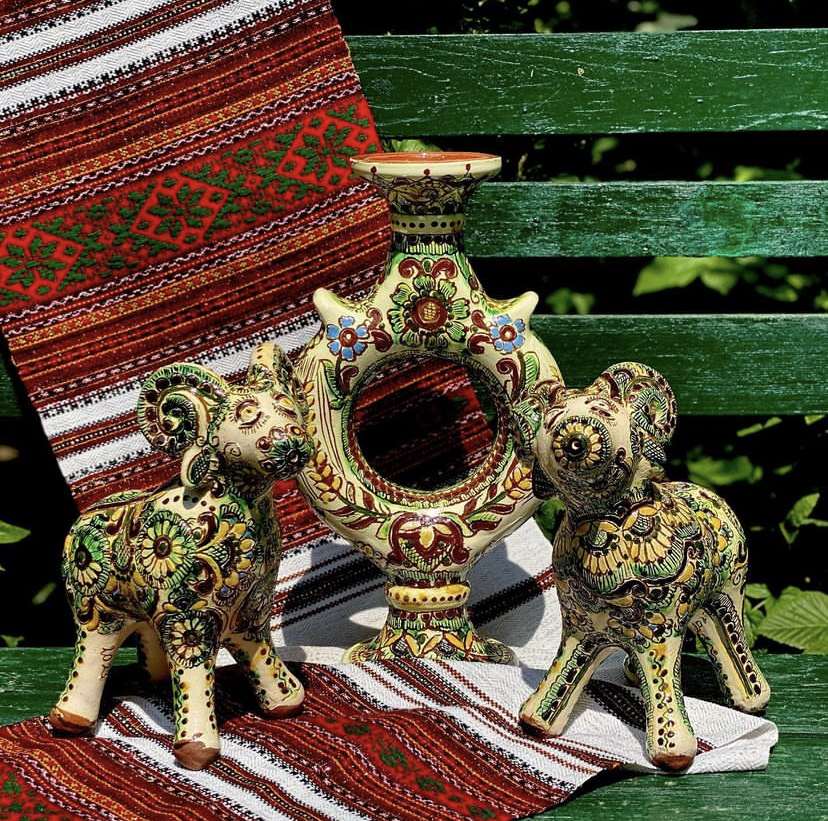
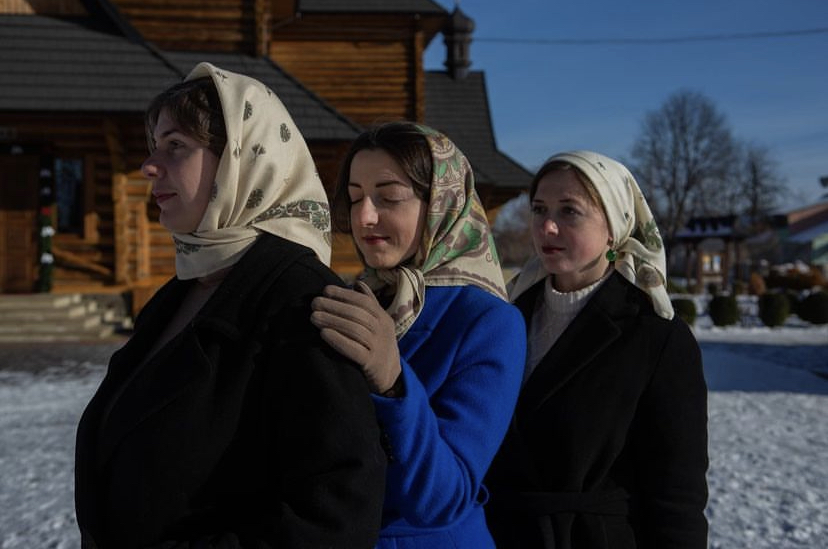
Auf den Fotos können Sie oben die Kosiv-Keramik und unten modernisierte ukrainische Taschentücher von Chichka sehen.
Sie sind herzlich eingeladen zu unserem Ukrainian Sound Garden Vol. 5, unserer besonderen Winterausgabe, die Hoffnung und Licht feiert. Wir freuen uns darauf, am 15. Dezember eine herzerwärmende Geschichte über die Kraft des Lichts zu teilen. Denken Sie zurück an Ihre Kindheitstage im Winter kurz vor Weihnachten – das Spielen im Schnee, das Heimkommen in einen gemütlichen, kerzenbeleuchteten Raum, gefüllt mit köstlichen Düften. Selbst wenn es draußen dunkel ist, fühlst du dich sicher und glücklich.
Kommen Sie in die Wärme unserer Winterausgabe, in der wir diese besonderen Momente zurückbringen wollen. Stellen Sie sich den Tisch von Oma voller Weihnachtsleckereien vor und die Freude, nach dem Abendessen ein kleines Geschenk zu erhalten. Zusammen wollen wir diese glücklichen Erinnerungen in Ukrainian Sound Garden Vol. 5 wieder erleben und teilen.
Wir sind fürs Bewerben unserer Veranstaltung dankbar und freuen uns, möglichst viele willkommen zu heißen und das Team und die Arbeit von Vitsche in einer entspannten Atmosphäre kennenzulernen.
Für weitere Details zum Lineup und zu den Event-Spezifikationen besuchen Sie unsere offiziellen Seiten und schauen Sie auf unseren Instagram– und Facebook-Seiten vorbei sowie auf unserem Telegram-Kanal.
In diesen herausfordernden Zeiten sollten wir uns an die Wichtigkeit erinnern, auch im Schatten die Fröhlichkeit zu finden. Und nicht zu vergessen, wie mächtig das Licht ist.
Medienkontakt:
Krista-Marija
press@vitsche.org
Kuratorin der Veranstaltung:
Serafyma Brig
serafima.brig@vitsche.org
Vor den Europawahlen 2024 vereinen wir, ukrainische Zivilgesellschaftsorganisationen mit Sitz in der Europäischen Union (EU), uns, um dieses Manifest zu präsentieren, das unsere gemeinsame Vision, Werte und Bestrebungen widerspiegelt. Unsere Mission ist es, für den Sieg der Ukraine, einen nachhaltigen Frieden mit Sicherheitsgarantien für die Ukraine und die Rolle der Ukraine in der EU einzutreten – was wir für wesentlich halten, um Demokratie, Sicherheit, Menschenrechte und Wohlstand auf dem Europäischen Kontinent zu wahren. Wir glauben, dass die Ukraine viel zu einem stärkeren, inklusiveren und friedlicheren Europa beitragen kann. Unser Manifest skizziert die Prinzipien und Prioritäten, von denen wir fest überzeugt sind, dass sie mit Millionen von Menschen in der gesamten EU resonieren.
Im Hinblick auf die bevorstehenden Europawahlen 2024 fordern wir die Europäischen politischen Parteien und Gruppen auf, ihre Verpflichtung und Unterstützung für den Weg der Ukraine hin zu nachhaltigem Frieden, wirtschaftlicher Erholung und Wiederaufbau, Demokratie und Gerechtigkeit zu bekunden. Die folgenden Schlüsselbereiche sollten Priorität haben.
I. Ukraines Europäische Bestrebungen: Unterstützung des EU-Beitritts der Ukraine
Wir glauben, dass das Schicksal der Ukraine eng mit der EU verknüpft ist. Wir sehen eine Zukunft vor uns, in der die Ukraine vollständig in die europäische Familie integriert ist und zu den gemeinsamen Werten der Demokratie, Freiheit und Menschenrechte sowie zur Entwicklung der EU-Wirtschaft beiträgt. Daher fordern wir alle europäischen politischen Parteien auf, die europäischen Bestrebungen der Ukraine in ihren Programmen anzuerkennen und die europäische Integration der Ukraine zu unterstützen.
II. Demokratie und Rechtsstaatlichkeit: Diese Prinzipien in den internen und externen Politiken und Entscheidungen der EU wahren und demokratische Reformen in der Ukraine unterstützen
Wir sind der Überzeugung, dass Demokratie und Rechtsstaatlichkeit unerlässliche Voraussetzungen für ein friedliches und wohlhabendes Europa sind. Dennoch sind diese grundlegenden Prinzipien nicht nur von Russland, sondern auch von verschiedenen autoritären Regimen weltweit bedroht. Europäische Parteien sollten deren Wahrung auf nationaler, europäischer und globaler Ebene uneingeschränkt sicherstellen.
Mit schwerem Herzen erkennen wir den kontinuierlichen Mut und die Opferbereitschaft der Männer, Frauen und Kinder der Ukraine an, die sich für diese geschätzten demokratischen Prinzipien einsetzen. Die tapferen Seelen, die sich angesichts des russischen Terrorismus und der raschistischen Ideologie der Verteidigung der Demokratie widmen, verkörpern das Wesen der Werte, die uns am Herzen liegen. Die Verluste der Ukraine in diesem edlen Anliegen dienen als eindringliche Erinnerung an die Dringlichkeit, dass europäische politische Parteien Mut und Solidarität zeigen müssen. Die Bedrohungen für Demokratie und Rechtsstaatlichkeit sind keine abstrakten Begriffe, sondern harte Realitäten, denen diejenigen an der Frontlinie des Kampfes zwischen Demokratie und Autokratie gegenüberstehen.
Angesichts des Krieges Russlands gegen demokratische Werte, die den Kern der EU ausmachen, müssen europäische Führungskräfte alles daran setzen, diese Werte zu bewahren. Dies ist essenziell, um die Souveränität der EU in der Zukunft, die Sicherheit und den Wohlstand der Bürger*innen angesichts der größten Bedrohung für die Weltordnung und die Rechtsstaatlichkeit seit dem Zweiten Weltkrieg zu verteidigen. Wir fordern außerdem die Unterstützung demokratischer Reformen und Transformationen in der Ukraine, die Stärkung der Zivilgesellschaft, Transparenz und Rechenschaftspflicht.
III. Frieden und Sicherheit: Kontinuierliche wirtschaftliche und militärische Unterstützung für die Ukraine und zukünftige Friedensgarantien
Wir unterstützen das Manifest für nachhaltigen Frieden “Nie wieder 2.03” der Vertreter der ukrainischen Zivilgesellschaft und fordern alle europäischen Parteien auf, es in ihre Programme aufzunehmen. Die volle Unterstützung der Ukraine bis zum Sieg erfordert kontinuierliche militärische, wirtschaftliche und politische Rückendeckung bis zum vollständigen Abzug der russischen Truppen aus allen besetzten Gebieten und der Wiederherstellung der ukrainischen Grenzen von 1991.
Die Ukraine verdient nicht nur Gerechtigkeit für die von Russland begangenen Verbrechen, sondern benötigt auch klare Zusicherungen für einen nachhaltigen Frieden. Der Weg dorthin beinhaltet den Beitritt der Ukraine zur EU und zur NATO. Die Entmilitarisierung und Entnuklearisierung der Russischen Föderation sind entscheidend, um das Risiko zukünftiger Aggressionen zu minimieren. Darüber hinaus wird Europa durch die Unabhängigkeit von allen russischen Energiequellen nicht nur die Möglichkeit nehmen, Energieversorgung als Waffe einzusetzen, sondern auch den Übergang zu grüner Energie in der EU beschleunigen. Ein nachhaltiger Übergang erfordert eine vollständige Abkehr von russischen Ressourcen, insbesondere von seltenen Erden, verflüssigtem Erdgas oder anderen.
Die politischen Führungskräfte der EU sollten den wirtschaftlichen Druck auf Russland weiter erhöhen, indem sie Sanktionen verschärfen, Schlupflöcher schließen, alle Formen von Energie verbieten und alle eingefrorenen russischen Vermögenswerte in der EU umleiten, um die Verteidigung und den Wiederaufbau der Ukraine zu unterstützen.
IV. Gerechtigkeit: Russland für seinen Angriffskrieg voll zur Verantwortung ziehen
Wie im Manifest für nachhaltigen Frieden hervorgehoben wird, erfordert die Verwirklichung nachhaltiger internationaler Sicherheit gleichzeitige Schritte in Richtung Gerechtigkeit und Frieden. Es ist notwendig, Russland für den Krieg voll und ganz zur Rechenschaft zu ziehen und ihm die volle Verantwortung zu geben. Diejenigen, die für Gräueltaten verantwortlich sind, müssen zur Rechenschaft gezogen werden – sei es für Angriffshandlungen, Kriegsverbrechen, Verbrechen gegen die Menschlichkeit, Völkermord, erzwungene Massendeportationen oder für die Verbreitung des Hasses, der einen noch nie dagewesenen Krieg im 21. Jahrhundert entfacht hat.
Zwar können nicht alle Verluste vollständig ausgeglichen werden, doch ist eine gründliche Bewertung des materiellen Schadens unerlässlich. Dazu gehört auch eine Bewertung der Schäden an den natürlichen Ökosystemen der Ukraine, die durch den russischen Angriffskrieg verursacht wurden. Wir müssen Russland auch für die immensen menschlichen Verluste und den Schock zur Rechenschaft ziehen, den Hunderttausende von Menschen, die ihr Leben verloren haben, und Millionen, die Angehörige verloren haben, erlitten haben. Entschädigungen sollten in angemessener Weise festgelegt und gezahlt werden. Unter anderem sollten sich die europäischen Parteien nachdrücklich für die Beschlagnahmung russischer Vermögenswerte und deren Verwendung für den Wiederaufbau der Ukraine einsetzen. Um die Rechenschaftspflicht zu stärken, muss Russland einen erheblichen Statusverlust hinnehmen. Es sollte von der Einflussnahme auf die internationale Politik durch Organisationen wie den UN-Sicherheitsrat ausgeschlossen werden. Ein Aggressor sollte keine Position in einem Gremium innehaben, das den Weltfrieden sichern soll.
V. Wirtschaftlicher Wohlstand und wirtschaftliche Wiederbelebung: Unterstützung von Reformen zum Wiederaufbau und zur Entwicklung einer widerstandsfähigen Wirtschaft der Ukraine
Wir streben nach einer wohlhabenden Ukraine in der EU, die Innovation, Unternehmertum und Entwicklung hin zu einer widerstandsfähigen und nachhaltigen Wirtschaft fördert. Wir fordern Maßnahmen, die ein günstiges Geschäftsumfeld schaffen, Korruption bekämpfen und eine gerechte Verteilung des Wohlstands gewährleisten.
Millionen in der EU lebende Ukrainer*innen stellen ein unschätzbares Gut dar, fähig, sowohl den EU-Ländern als auch der Ukraine durch den Austausch von Wissen und Erfahrungen Vorteile zu bringen. Dies kann erheblich zu den Wiederaufbaubemühungen der Ukraine beitragen. Wir setzen uns nachdrücklich für die Entwicklung von Programmen ein, die die zirkuläre Migration fördern und die Einrichtung von Geschäfts- und Forschungskooperationen unterstützen, die gegenseitig vorteilhafte wirtschaftliche Verbindungen zwischen der Ukraine und den EU-Mitgliedstaaten fördern können.
VI. Umweltverantwortung: Umweltschutz und Nachhaltigkeitsprinzipien in der Nachkriegs-Wirtschaftsrekonstruktion priorisieren
Wir setzen uns für die Förderung von Umweltnachhaltigkeit und den Kampf gegen den Klimawandel ein. Wir befürworten verantwortungsvolle Umweltregelungen und den Übergang zu einer nachhaltigen Wirtschaft, die die planetarischen Grenzen respektiert. Der Schutz unseres Planeten ist eine gemeinsame Verpflichtung, die von allen Europäer*innen geteilt wird. Wir fordern die EU auf, die Nachkriegsreformen auf der Grundlage der Prinzipien der Klimaneutralität, der Kreislaufwirtschaft und des Erhalts der biologischen Vielfalt in Einklang mit den Prinzipien des Europäischen Grünen Deals zu unterstützen.
Die anhaltenden ökologischen Schäden, die Russland in der Ukraine verursacht, wie durch die Zerstörung des Kachowka-Staudamms verdeutlicht, unterstreichen die dringende Notwendigkeit für alle EU-Nationen, die für Ökozid und ähnliche Umweltkatastrophen Verantwortlichen anzuerkennen und zu verfolgen. Daher fordern wir die europäischen Parteien auf, Ökozid als Verbrechen gegen die Menschlichkeit in die europäische Gesetzgebung aufzunehmen.
Ebenso wichtig sind die Bekämpfung des nuklearen Terrors und die Abschreckung möglicher nuklearer Katastrophen, die durch russische Aktionen provoziert werden, wobei die russische Eroberung der Kernkraftwerke Tschornobyl und Saporischschja als schockierende Präzedenzfälle gelten.
VII. Europäische Identität und Kultur: Bemühungen zur Bewahrung und Förderung der ukrainischen Kultur unterstützen
Wir feiern die Vielfalt der europäischen Kulturen und Sprachen. Wir fördern die Erhaltung des kulturellen Erbes und die Förderung des interkulturellen Dialogs. Ein starkes Europa umarmt sein reiches Geflecht an Identitäten.
Als Reaktion auf Russlands systematische Verbrechen gegen die ukrainische Kultur fordern wir die europäischen politischen Parteien auf, eine entschlossene Haltung gegen diese Aktionen einzunehmen. Dies beinhaltet die Verurteilung der absichtlichen Zerstörung und des Diebstahls des ukrainischen Kulturerbes durch Russland, als Teil eines breiteren Musters von Kriegsverbrechen anerkannt.
Westliche Gesellschaften müssen ihre Stereotypen über die russische Größe, wie sie über Jahrhunderte von der russischen Propaganda genährt wurden, ablegen. Diese haben seine imperialistische Aggression und kolonialen Politiken gegenüber Nachbarländern angeheizt. Die ukrainische Kultur sollte von der russischen entkoppelt werden, indem ihr einzigartiges kulturelles Erbe anerkannt und der Mythos der „Brudernationen“ widerlegt wird. Die EU sollte das Bewusstsein dafür schärfen, dass die ukrainische Sprache einzigartig und unabhängig von der russischen Sprache ist, insbesondere indem sie in diplomatischen und kulturellen Kommunikationen gleichberechtigt behandelt wird.
Europäische Parteien sollten ihre Unterstützung für Bemühungen zur kulturellen Erhaltung durch die Bereitstellung von Expertenwissen, finanzieller und logistischer Unterstützung für ukrainische Kultureinrichtungen und Organisationen ausdehnen, die sich bemühen, wertvolle Kunstgegenstände und Kunstwerke, die beschädigt oder gestohlen wurden, zu bewahren und wiederherzustellen. Darüber hinaus kann die Förderung von Partnerschaften mit europäischen Museen und kulturellen Einrichtungen entscheidend sein, um gestohlene kulturelle Schätze zu bergen und zu rehabilitieren.
Zusätzlich fordern wir zukünftige europäische Führungskräfte auf, das historische Bewusstsein zu schärfen und die Bemühungen zur Förderung der ukrainischen Kultur auf internationaler Ebene zu unterstützen, indem sie diplomatische Kanäle, Medienplattformen und den öffentlichen Diskurs nutzen, um die kulturellen Verbrechen Russlands in der Ukraine von der Geschichte bis heute zu beleuchten. In Zusammenarbeit mit internationalen Organisationen wie der UNESCO sollten sie Bemühungen vorantreiben und konkrete Maßnahmen ergreifen, um das ukrainische Kulturerbe weltweit zu bewahren.
_____________________________________________________________________
Auf unserem Weg nach vorne, vereint in unserer Vision, laden wir die europäischen Bürger*innen und politischen Entscheidungsträger*innen ein, sich uns anzuschließen und ein stärkeres und widerstandsfähigeres Europa zu unterstützen. Gemeinsam können wir einen Kontinent aufbauen, der Freiheit, Demokratie und Menschenrechte schätzt und in dem alle Nationen, einschließlich der Ukraine, zu einer besseren Zukunft für kommende Generationen beitragen.
Unterzeichner*innen des Manifests:
Marta Barandiy, Gründerin und Präsidentin, Promote Ukraine, Belgien
Khrystyna Monastyrska, Koordinatorin, Unlimited Democracy – Verein zur Förderung der
Demokratisierung, Österreich
Kseniia Mukhortova, Mitbegründerin und Herausgeberin, UKRCY.News, Zypern
Svyatoslav Kalishchuk, Mitbegründer, Spilka, Tschechische Republik
Julia Chenusha, Geschäftsführerin Blau-Gelbes Kreuz Deutsch-Ukrainischer Verein e.V., Deutschland
Hanna Slobodyanyuk, Vorstandsmitglied, IWEK, Mykolaiv Water Hub, Deutschland
Iryna Shulikina, Geschäftsführerin, Vitsche E. V., Deutschland
Vassili Goutsoul, Vorstandsvorsitzender, Ukrainischer Verband in Finnland, Finnland
Anastasiia Shapochkina, Präsidentin, Eastern Circles, Frankreich
Ivanna Pinyak, Mitbegründerin, PromoUkraїna, Frankreich
Iryna Katyuk, Präsidentin, Spilka Paris, Frankreich
Edward Mayor, Mitbegründer und Präsident, Stand With Ukraine Europe, Frankreich
Lesia Ignatyk-Eriksen, Vorsitzende, Association at Ukrainere i Danmark, Dänemark
Yuliia Kryzhanovska, Vizepräsidentin, Ukrainische Frauen in Griechenland, Griechenland
Olena Redrugina, Mitbegründerin und Vorstandsmitglied, Ukrainian Action in Ireland, Irland
Maryana Semenyak, Vorstandsmitglied, Associazione Cristiana degli Ucraini in Italia, Italien
Zoia Stankovska, Präsidentin, UAMi, Italien
Federica Antonacci, ItalianaforUkraine, Italien
Inna Yaremenko, Vizepräsidentin, LUkraine, Luxemburg
Oksana Savchuk, Mitbegründerin, VATAHA Foundation, die Niederlande
Emma Zahynaiko, Koordinatorin, Euromaidan Warszawa + Stand with Ukraine Foundation,
Polen
Stanislav Olenchenko, Mitbegründer, Ukraine Explainers, Polen/Ukraine
Andrii Vovk, Freiwilliger, Support Ukraine Slovakia, Slowakei
Liliya Mykolaiv, Präsidentin, ConUkrania, Spanien
Maksym Girnyk, Sprecher, Nordic Ukraine Forum, Schweden
Hat Eure Organisation Interesse, das Manifest zu unterzeichnen? Dann setzt Euch gern direkt mit der Organisation Promote Ukraine zu Verbindung.
We are pleased to present the pilot study “ Map Renovation”on the experience of Bosnia and Herzegovina in heritage preservation.
The country survived the Bosnian genocide and the war of 92-95, and the capital city experienced the longest siege in modern history. The destruction of heritage in Bosnia was extremely extensive, and it is officially established that the country’s unique multicultural heritage was a military target. The case of Bosnia is of great importance for the development of international law in the field of cultural heritage, as well as the right of people to restore it. The project studies the context, nature and extent of the destruction, the reaction and actions of the international community. The study examined how local institutions and volunteers acted and the role of various initiatives in the period of post-war reconstruction.
After legitimately declaring its independence from Yugoslavia through a national referendum in 1992, Bosnia and Herzegovina (BiH) experienced war and the genocide of Bosniaks, one of three main ethnic groups.
Perhaps the most important historical feature of BiH was the compact living in one space of different ethnic groups: Bosniaks (predominantly Muslims), Croats (predominantly Catholics), Serbs (predominantly Orthodox). Typical smaller towns and villages could have a Catholic church, a Muslim mosque, an Orthodox church, and sometimes a Jewish synagogue within meters of each other. Such evidence of the coexistence of religions was being violently eliminated. The independent status of Bosnia and Herzegovina, which was supported by Bosniaks and Croats, did not satisfy a part of the Serbian population, which saw its future as part of a large mononational state. The illegitimate declaration of independence of territories, predominantly inhabited by Bosnian Serbs, which were later became known as Republika Srpska and the massive personal arming of the serbian population in BiH only confirmed the seriousness of the Serbs’ intentions.
The war in Bosnia led not only to a huge number of human casualties, but also to large- scale destruction of urban structures and cultural objects. Such events had a significant impact on the global experience of heritage preservation, because they allowed to verify in practice the effectiveness of the existing specialized inter- national institutions and pointed out the short- comings in the approaches to the protection of culture and rights to it. Today, almost 30 years after the end of the war in Bosnia and Herzegovina, the process of restoring the destroyed cultural heritage remains one of the important tools for achieving the much-needed justice for Bosniaks and asserting their right to exist.
Targeting cultural identity, damaged heritage sites and landmarks, erasing traces of culture, – it is the reality of Ukraine and the recent past of Bosnia and Herzegovina. We discussed the modern challenges and key risks of heritage preservation, restoration, and rebuilding with Bosnian and Ukrainian specialists. Watch the full discussion here.
The experience of Bosnia and Herzegovina in heritage restoration is extremely valuable for Ukraine in the context of preserving culture and national identity. Knowledge about the activities of the international community and the role of local initiatives in the reconstruction of Bosnia and Herzegovina will help to set up the processes of effective cooperation with partners and achieve positive results in the restoration of cultural heritage in Ukraine.
Read the full study here:
It’s been almost a decade since Russia illegally occupied Crimea. As Russia continues to wage its full-scale war against Ukraine, the peninsula is both a strategic military base for Putin’s regime and the ultimate goal for Ukraine as it moves to liberate its territory.
A decade of Russian rule has harmed the peninsula and especially Crimean Tatars [indigenous people of the Crimean peninsula], who have been subjected to repression and have been once again forced to leave their homeland en masse. Although liberation of Crimea remains a long-term goal, it’s important to consider how Ukraine will reintegrate the region after de-occupation and how the international community can help, while ensuring that Russian aggression doesn’t go unpunished.


Credits: https://lnk.bio/LMF_Communities
The future of Crimea was at the center of an LMF Talks event held by Lviv Media Forum in Berlin on October 26. Moderated by Marieluise Beck, Senior Fellow of the Center for Liberal Modernity. The discussion featured:
- Sevgil Musayeva, editor-in-chief of Ukraine’s top online newspaper Ukrainska Pravda and one of Time magazine’s top 100 most influential people of 2022;
- Maria Tomak, head of the Crimea Platform Department at the Mission of the President of Ukraine in the Autonomous Republic of Crimea;
- Wilfried Jilge, Associate Fellow at the German Council on Foreign Relations (DGAP), expert on Ukraine and Wider Black Sea region.
We picked key highlights from the discussion, edited for length and clarity.
Russian repressions in Crimea started in 2014, and the world did not pay attention
Sevgil Musayeva: “In 2014, Russia started with the same [repression] tactics in Crimea [as Russian regimes did in the past]. First, they forced all independent Ukrainian media to leave; 18 outlets left in the first year of occupation. They banned Crimean Tatars’ Memorial Day [that commemorates victims of the deportation during the Second World War]. In 2016, just two years after the occupation, they recognized Mejlis, the representative body of the Crimean Tatars, as an extremist organization. In Mejlis, we have 20,000 members… all of them became a target”.
These violations have deep historical roots. Maria Tomak recommended reading the report by Dunja Mijatović, Commissioner for Human Rights of the Council of Europe, on the human rights situation of Crimean Tatars in the peninsula. “What amazed me is that she started the report from the 18th century, from the first annexation of Crimea. That shows very clearly the pattern of Russia eliminating Crimean Tatars since the first occupation”.
But reports about violations of human rights in Crimea, about political prisoners from human rights defenders, were not taken seriously before the full-scale invasion, Sevgil Musayeva believes. The first victim of Russian aggression in Crimea was Reşat Ametov; he was killed in March 2014 just for organizing a peaceful protest. “Now we have… thousands of civilian victims in Ukraine, a big humanitarian crisis. These stories are connected. It started in 2014, it started with the murder of Reşat Ametov. Because nobody took it so seriously, nobody bore the responsibility, we’re now here – with all the crimes and violations of human rights that Russia committed in Ukraine”.
The liberation of Crimea is critical not only to Ukraine but also to global security
Sevgil Musayeva: “[The future of Crimea is connected to] security in the Northern Black Sea Region. [With Crimea] Russia has a military base in Black Sea. Today Russia uses it as a weapon against Ukraine, launching missiles from occupied Crimea. But tomorrow, it can also use this military base in other conflicts. In this region, we have countries that are members of the European Union, that are members of NATO. That is why the “Ukrainian crisis”, as it is often defined in the West, cannot be solved without solving Crimea”.
Wilfried Jilge: “If Russia has Crimea under its control, it can cover [with cruise missiles and other long-range weapons] all coasts of Black Sea and have a power projection against NATO in the Eastern Mediterranean”.
Wilfried Jilge: “[Controlling] Crimea has two aims for Russia. First it is, even if the war stops, to permanently destabilize Ukraine. Second, it is part of the restitution of the so-called imperial sphere of influence of Russia. [Crimea is] a springboard to then go [seize more territory]. It is very crucial to understand that the Middle East and the Eastern Mediterranean, where the United States Sixth Fleet is crossing, is also a target. So [Crimea] is not about only the security of Ukraine, it is about our common security.”
Crimea will eventually be liberated; Ukraine and the international community should be prepared for a long and complex reintegration process
Maria Tomak says that Ukraine is already preparing for de-occupation of Crimea and for the reintegration process that will be happening afterwards. We don’t yet know how the liberation of Crimea will happen precisely – “hopefully, Russia will just get out of Crimea at some point, but we understand that there might be a military operation by the Armed Forces of Ukraine” – but it’s critical to be prepared for what comes after.
Maria Tomak: “Next day after de-occupation, what are we going to do as a state? We have tons of problems, of course.
We have the whole administration issue – how do we administer this system? We need 50,000 people for the administration. We need to find the [right] approach, we cannot just bring all the people from mainland Ukraine. We need to go after people who have been [working for occupying administrations] and have been engaged in war crimes, crimes against humanity. But then, of course, we need to engage local people who were not cooperating with the occupying authorities in the administration of Crimea.
There is a huge issue with the justice system. So far, occupiers’ courts produced 1.2 million decisions in 10 years. Of course, the Ukrainian justice system will not [have the capacity] to review all of them. We need to invent some blanket approaches, such as not accepting decisions related to nationalization of the property for the Russian state and not accepting decisions within the politically motivated cases.
We have a big problem with property rights – people are buying and selling properties, new objects are built, old objects are destroyed.
Of course, one of the most complicated issues is dealing with humanitarian space. [We need to deal with] ten years of really harsh brainwashing and militarisation, including among children, a total reshaping of the public space and adjusting it to Russian propaganda proposals…
One more issue that inevitably will pop up is that Russia brought at least half a million, perhaps up to 800,000 of Russian citizens in Crimea since the beginning of occupation… We cannot afford to leave them in Crimea and pretend that everything is fine. We understand that it’s not possible. But, of course, Ukraine is not going to make massive deportations that contradict international law. We will definitely make these people leave Crimea, but if there are those who think they have a legitimate right to stay in Crimea, they might apply [for a permission to do so]. This mechanism should be invented”.
Useful resources:
- Ukraine’s priorities after de-occupation of Crimea
- Ukraine’s strategy for the restoration of Crimea after de-occupation
Investigators: M.K., Vasile Popa, Francisco A., Christian Mamo, Julia Hüske, Patryk Grazewicz
Authors: Christian Mamo, Julia Hüske
Edited by: Deniz M. Dirisu, Krista-Marija Läbe

A boxy, imposing yet somewhat shabby structure overlooking Berlin’s Friedrichstrasse, the Russian House, much like its eponymous nation, has seen better days. Founded in 1984, the institution purportedly exists to promote Russian culture, language and soft power – a Russian version of the Goethe Institute. Since 2008, it has been run directly by Rossotrudnichestvo, a government agency, subsidiary to the foreign ministry, which handles the Russian state’s cultural exchange schemes.
However, details regularly emerge which suggest that the role of the Russian House in Berlin goes well beyond cultural promotion.
Rossotrdunichestvo was placed under sanctions by the European Union in July 2022 and described as a network of “agents of influence” spreading Moscow’s political narrative. The Russian House, falling under the management of Rossotrudnichestvo was affected and had to curtail many of its regular activities.
Despite this, it has managed to avoid having to entirely shutter its doors. The institution continues hosting and advertising events, ranging from film screenings to language classes. Visitors can still buy Russian food on the premises, as long as they pay cash.
On this last point, this appears to be a rather open if trivial violation of the sanctions regime placed on Rossotrudnichestvo and its affiliated institutions. Any monetary transaction with Russian state institutions is now forbidden in the EU – the Russian House remains open on the condition that it can’t generate any income from its operations. However, this appears not to be the case – any visitor can buy some Russian food from the building’s second floor restaurant or book ceramics classes for 30 euros an hour.


Beyond this, several businesses remain registered on the Russian House’s premises, presumably not for free. Some of these continue to host events, charging admission fees. Euro Pop, an annual “international” music competition hosted by the Russian House since 2003 will have its 20th edition this year in November.

The Russian House has been managed by Pavel Izvolskiy since 2017. A soft-spoken, well-mannered man, Izvolsky presents a clean image of the management of the institution and has positioned himself as a key component of cultural exchange between Russia and Germany. Izvolsky is a former employee of Rosatom, the Russian state nuclear energy agency, and earlier this year found his name mentioned in German media. German public broadcasters were forced, for unspecified “legal “reasons” to redact sections of their article on Izvolsky which quoted a claim from Russian investigative outlet “The Insider”. According to the redacted claim, Izvolsky was once registered as living in a dormitory of the Moscow Higher Military Command School (MVVKU), renowned for providing cadets for Russian intelligence agencies. Journalists from ukrainian Toronto TV could verify this information using leaked Russian databases.
In general, there do seem to be several Rosatom affiliates around the Russian House. Before May 2022, RH Events UG, a company involved in event management, e-commerce and software development, was officially registered at the address of the Russian House. The director of RH Events, Andrey Chubarov, works at the same division of Rosatom (Rusatom Overseas) as Izvolsky had, according to the two mens’ Linkedin profiles.
Then there is Evgenia Pimenova. According to her Linkedin, she is the Russian House’s current “Abteilungsleiter” – roughly translated to “head of department”. Like a surprising amount of the Russian House’s administrative staff, she is a graduate of MGIMO, a prestigious Russian university focusing on international relations, which has a reputation of being an incubator for Russian diplomats, foreign officials and spies. She has contributed to the notorious Izvestiya since at least 2016. Izvestiya was founded in 1917 as the official state propaganda paper of the Soviet Union’s politburo and describes Pimenova as a political scientist in her byline.
This work experience is conspicuously missing from her Linkedin. An October 2021 article of hers in Russian Publication “Svobodnaya Mysl” (the successor of Soviet-era theory magazine “Communist”) refers to Pimenova as a “consultant” at Berlin’s Russian House. There is also no mention of this on her Linkedin.
Connections to “Alternative für Deutschland” (AfD)
Yet, at least in the German context, even more damning connections appear. Anyone with sufficient interest looking into the operations of the Russian House will find substantial ties with far-right party AfD. While it is little secret that for decades a major part of the Russian state’s policy towards Western Europe has involved the support of fringe political movements, this is particularly relevant with the AfD’s recent electoral surge.
Amram Petrosian gives a hint of these ties. Born in Ukraine, Petrosian is president of Rossotrudnichestvo “partner” the “Fund for the Development of Modern Diplomacy”. This appears to be a think tank of sorts that has been advocating lifting the anti-Russian sanctions even prior the full scale invasion. According to the recent investigation by ukrainian media “Toronto TV” from 22.10, Petrosian’s “Fund for the Development of Modern Diplimacy” is also related to Leonid Vakalov, agent of 5. Department of FSB, who attended one of the forums and also is registered in Petrosian’s company “Sfera” as a manager.

In October 2021, the Fund boasted that Petrosian was admitted to the AfD’s expert council of the Inter-Parliamentary Commission on Human Rights – Kazakhstan-born AfD deputy Waldemar Herdt, signing off on the admission, praised Petrosian’s “valuable expertise”. No longer in the Bundestag, Herdt has been a regular guest on Russian television and is known for propagating dubious Kremlin narratives.
Perhaps the strongest of these connections are seen with Jürgen Elsässer. Elsässer is an outspoken political activist of the German right. A founder of the anti-Deutsche movement, Elsässer was a major figure in German left-wing media before making an ideological pivot to the right. In 2010, he founded COMPACT, a media company which has functioned as the semi-official media mouthpiece of AfD. In 2021, German intelligence branded COMPACT as an “extremist” publication.
According to German media, Elsässer and COMPACT have regularly held events at the Russian House since 2010 – every two weeks at times. One of these events, in 2014, was a presentation of a COMPACT publication, a collection of translated Putin speeches. This event was attended by the Russian embassy’s press attaché. COMPACT has also developed a reputation for inflammatory rhetoric, often bordering on outright racist. At one point, the publication called for the release of Beate Zschape, a member of a neo-nazi gang found guilty in the murders of ten immigrants. Unsurprisingly, the publication’s editorial stance favours the Russian state in its invasion of Ukraine and the writings regularly reference Russian pseudo-fascist “philosopher” Alexander Dugin.
The connections with AfD don’t end there, and Elsässer appears to be an important conduit between the party and the Russian House. In August 2023, together with André Poggenburg, the COMPACT founder organised a summer festival in Saxony-Anhalt under the motto “Freedom for Germany and Peace with Russia”. Poggenburg, once part of the extremist “wing” of the AfD, left the party after a racism scandal in 2019. Among the invited guests was the pro-Russian activist Elena Kolbasnikova, known in Germany as “Putin’s fangirl”. The activist and Poggenburg co-founded the initiative “Awakening, Peace, Solidarity, Justice” (Aufbruch, Frieden, Solidarität, Gerechtigkeit), which regularly organises pro-Russian motorcades across the country. According to a Times investigation, suspicion of state orchestration arises from pro-Russian motorcades held across Germany and Europe, with experts suggesting Rossotrudnichestvo may be directing diaspora members in these activities.

Markus Beisicht, Elena Kolbasnikova and André Poggenburg in Russian House giving an interview. Source: @m_dorn_, X
On September 9, a pro-Russian rally was held in Berlin, co-organized by Kolbasnikova and Poggenburg. As usual, the rally was filled with the usual slogans of “peace” and stopping weapons deliveries to Ukraine – it also involved a rendition of the “full” German national anthem, including redacted verses containing Nazi-affiliated slogans. These were played alongside the typical Russian patriotic songs. After the rally, the organisers made a video with their closing remarks – stills from the video clearly show that it was made on the premises of the Russian House.
Vadar e.V., an association founded by AfD members during the Russian invasion, has been campaigning for Russian interests since 2022. Among the co-founders and chairmen are AfD former member of parliament Ulrich Öhme, AfD MP Eugen Schmidt and Berlin AfD candidate Dr. Michael Adam. Other members of the association are also affiliated with the right-wing party, such as Harald Weyel, AfD vice treasurer, Gunnar Lindemann (AfD Berlin) and Olga Petersen (AfD Hamburg).
Lindemann attracted attention in the years before the war through his various trips to Crimea, which was annexed by Russia in 2014. The annexation of Crimea and the invasion of eastern Ukraine are seen as symbols of the Putin regime’s imperial aspirations, a harbinger of the Russian war of aggression against their neighbour. This did not stop the spokesperson for local public transport for the Berlin AfD from flying to “business forums” in Yalta and speaking at an “anti-fascist congress” in Sevastopol. Beyond that, the politician has received an “Order for Peace-Promoting Measures” at a “Peace-Keeping Forum” and has stated that he had also been to Luhansk and Donetsk several times before last year’s invasion. Oehme, who is now employed by an AfD MP, travelled to Crimea to participate in a referendum at the expense of the Russian State Duma, and praised the conduct of the parliamentary elections.
According to the purpose section on its website, Vadar aims to combat the alleged discrimination against Russian-speaking people in Germany. The activities of the group provide information about its questionable understanding of discrimination. As per their own statement, the association provided financial support for the legal representation of pro-Russian influencer Alina Lipp. The Putin propagandist is being investigated in Germany on charges of showing approval for the Russian war of aggression and thus criminal offences on social media.
Various posts defending the pro-Russian activism of Kolbasnikova and her husband Maxim Schlund, a former Russian air force officer, on the grounds of “freedom of expression” were published on Vadar’s telegram channel. Furthermore, a man from Frankfurt am Main, who is currently a prisoner of war in Ukraine, is supported by the association. He was captured after voluntarily joining the Russian armed forces.
Research suggests that both Kolbasnikova and Vadar e.V. are active in the orbit of the Russian House. On 3 November 2022, a video showcasing donations to Donbas surfaced on the telegram channel of the operator of the house, the sanctioned agency Rossotrudnichestvo – the post named Kolbasnikova personally. A Reuters investigation published in January 2023 found that Rossotrudnichestvo paid for plane tickets to Russia for Kolbasnikova and her husband. The couple was scheduled to attend a state-organised forum for civil society activists in Moscow but missed the flight. In an online post to her supporters, Kolbasnikova herself revealed Russian House as the ticket sponsor. Rossotrudnichestvo denied involvement, but Grigory Mikhitaryants, an official at the Russian House in Berlin, confirmed to Reuters the purchase of two tickets to Moscow, without revealing any names.
Since it has become subject to investigations, Vadar has spoken out against the possible closure of the Russian House and has advertised its events in cooperation with COMPACT. On one occasion, Vadar called for an investigation into pro-Ukrainian activists – the reason they gave was that these activists supposedly protested against the screening of a Russian childrens’ film, Cheburashka, and, in Ukrainian called for burning Russian children. A search for this alleged protest yields few results and appears to actually be from a protest against an exhibition of Soviet tourism posters.
Upon closer examination of the video, Vadar’s narrative falls apart. The video in question shows one placard bearing the face of Walter Benjamin, with the slogan “the aestheticization is war”. This exact distinctive placard is seen in the exact same position in photos taken by German media of Ukrainian activists protesting against an exhibition of Soviet tourism posters at the Russian House. The banner next to the Walter Benjamin placard is also the same. Then there’s the matter of what was said at the protest. The brief clip that has been floating around pro-Russian media cuts off quite abruptly. What exactly the protesters are chanting is unclear – however it is clear what they aren’t.


For starters, the decipherable words of the protesters aren’t even in Ukrainian, as claimed, but in Russian – “vashy deti” is clearly heard, meaning “your children” in Russian, as opposed to “vashi dity” in Ukrainian. The last two words chanted by the protesters – which Vadar claims is calling for the burning of Russian children – are undecipherable. However, they sound nothing like “will burn” in neither Russian or Ukrainian.
One figure affiliated with Vadar e.V. has recently attracted particular media attention. The Ukrainian-born, Berlin-based author and journalist Vladimir Sergienko, an aide to AfD MP Eugen Schmidt, is accused of working with Moscow to delay German tank deliveries to Ukraine.
Recent “Spiegel” revelations have shown that Sergienko was involved in trying to obtain financial support from Russia to back an AfD lawsuit against German arms exports to Ukraine. The information comes from a data set that includes emails, official documents and correspondences attributed to Sergienko, accessed by the “Spiegel” and investigative platform “The Insider”.
In July, the AfD parliamentary group actually filed a complaint with the Federal Constitutional Court concerning arms deliveries to Ukraine. Still, the party denies any cooperation with Sergienko on this matter.
Diverging from Vadar, an AfD-affiliated association called Druschba Global, with several regional branches throughout Germany, existed prior to Russia’s current invasion of Ukraine. It dates back to 2016 when AfD parliamentarian Dr. Rainer Rothfuss established the organisation, catalysed by his recurrent visits to Russia. Since its founding, Druschba Global has organised numerous so-called ‘peace trips’ to the country.
A closely-knit relationship prevails between Druschba and its co-founder German-Russian Sergei Filbert, who actively spreads pro-Russian narratives on his Telegram channel DruschbaFM and his YouTube platform ‘Golos Germanii’. The association itself also operates a Telegram channel known as DruschbaINFO. There, Druschba champions pro-Russian activists like Kolbasnikova and Schlund, propagates the Russian war perspective and rationalises Moscow’s war in Ukraine. Under a video showing Ukrainian prisoners of war posted on the channel, Rothfuss calls capitulation the best solution for Ukrainian soldiers.

Beyond this, Druschba maintains further close connections with right-wing groups. This is evidenced by images on social media portraying the AfD politician alongside the conspiracy theorist rapper Owe Schattenauer, co-organiser of Druschba’s Russia trips, and members of the Night Wolves. Rothfuss has visited the Putin motorcycle club during a Crimea expedition in years previous to the war, and speaks admiringly of the Night Wolves’ leader, Alexander Saldostanov.
Druschba’s endeavours also demonstrate a linkage to the Russian House. In August 2022, the Berlin institute featured a Druschba trip under the slogan “peace with Russia” on its official Facebook page. The post detailed the mission’s objective: to show that many Germans “don’t like the Russophobic stance of the west”. Frieden und Freundschaft mit den Völkern Russlands e.V., located inside the cultural institute, promotes and lists Druschba as one of their partners.
Another Druschba affiliate of interest is Konstantin Ermish. A former Druschba board member, Ermish is Saxony’s representative of the Government Commission on Compatriots Living Abroad (KSORS). This state institution was founded specifically to coordinate the Russian diaspora throughout the world. KSORS gets its money from the sanctioned fund Russkiy Mir, founded by decree by Putin.
Interestingly, the Berlin chapter of KSORS is, or at least used to be registered at the Russian House’s premises. The Russian House’s official Facebook page also has multiple past posts advertising KSORS events which were to be held at the Russian House. This provides a possible hint at one of the institute’s sources of funding.
Propaganda and “Charity” Organizations
Besides the obvious Putin propagandists, DruschbaFM frequently hosts guests affiliated with purported humanitarian organisations. Among these individuals is Ivana Steinigk, the chairwoman of the Thuringian association “Action Alliance Future Donbas” (Aktionsbündnis Zukunft Donbas). While Steinigk claims that the association, established in 2016, maintains a fundamentally apolitical stance, she consistently promotes Russian war narratives in her media interviews and on social media platforms. She asserts that Russia is making every effort to minimise civilian casualties in Ukraine, thereby refuting allegations of Russian war crimes. She also claims that Ukraine is to blame for the escalation into war by torpedoing the Minsk agreement – two major Kremlin propaganda talking points.


This alliance appears to have found a comfortable place within the network of right-wing pro-Russian groups and organisations in Germany. On her Facebook profile, Steinigk, who goes by the social media pseudonym “Berntowna”, has connections with aforementioned AfD member Gunnar Lindemann and Alina Lipp. Furthermore, the right-wing extremist group “Free Saxons” openly supports the aid convoys organised by the Future Donbas. The alliance also appears to collaborate with other right-wing groups, such as the “Patriots Novorossija” and a branch of the German-Russian Brotherhood known as the “German-Russian Souls” association. Photographs from their Donbas aid transports depict vehicles adorned with the Russian war symbol “Z”.
And the organisation appears to at least be attracting the attention of actual Russian state institutions. In March 2022, almost a month after the start of the Russian war of aggression, the Russian consulate in Leipzig praised the alliance’s work in a tweet. Then, in December that year, Zukunft’s Facebook page boasted of delivering 36 trucks’ worth of “humanitarian supplies” to Donbas, with the help of Russia’s federal Ministry of Emergency Situations.
Another questionable pseudo-humanitarian organisation is Friedensbrücke. This “charity” has Liliana Kilinc as its founder, a former Die Linke member who left due to the party’s alleged “inadequate anti-imperialist stance”. Kilinc has been involved in advocacy for the Donbas separatists since at least 2015 when she founded Friedensbrucke.
Photos on social media show Kilinc posing alongside boxes of “humanitarian supplies” under Russian imperial flags. Last year, the organisation found itself under investigation after publishing a video of one of its trucks displaying the Z symbol. Furthermore, there have been persistent allegations of Friedensbrücke delivering combat supplies to the Russians and their separatist proxies – in February according to investigative outlet The Insider, the organisation paid for the delivery of an anti-drone weapon and a drone system for a unit of the so-called LPR. These revelations have cost Friedensbrücke their NGO status – now they are reduced to asking for donations on GoFundMe.
And these are not unfounded accusations. According to the same article, Kilinc has extensive collaborations with the Russian nationalist types crusading for the Donbas separatists. In November 2022, in a Vkontakte post, Saule Ivanova, a coordinator of the “Moskva-Donbas” volunteer group directly supporting separatist military formations, personally thanked Kilinc for the delivery of a substantial amount of motor oil. According to the post, the substance, which is crucial for the movement of armoured vehicles, would go directly to motor rifle units of the separatists. All of this information comes from the same Insider article.
Perhaps unsurprisingly, Kilinc currently resides in Russia.
The Berlin GRU Community
Then, rounding off the network of questionable figures surrounding the Russian House is Oleg Eremenko. In a Reuters article from January, Eremenko admitted to being a former member of the GRU, the Russian military’s foreign intelligence agency.
The exact nature of Eremenko’s connection to the Russian House is still unclear. However, several bits of information floating in the public sphere give a hint about his role. In a September 2022 interview with Russian TV, Eremenko mentioned that he passes Checkpoint Charlie everyday on the way to his work – the Russian House is located a stone’s throw from the historical site.
Regardless, Eremenko clearly spends much of his time at the Russian House. His Facebook profile shows several photos of him on the premises of the institution. Earlier this year, when German journalists from Stern called the Russian House to enquire about Eremenko, they were told that he wasn’t on site that day.
With it being established that, at the very least, Eremenko is closely affiliated with the Russian House, it’s worth looking into his other activities. In a photo dated from 2016, Eremenko is seen photographed with Igor Strelkov (aka Igor Girkin), a former Russian intelligence officer who played the decisive role in organising the Ukrainian separatist movements in Donbas, and played a major role in the military functions of the so-called Donetsk and Luhansk people’s republics. Eremenko claims his acquaintanceship with Strelkov resulted from his deliveries of “humanitarian supplies” to Donbas.


Eremenko is also active in a number of official and semi-official organisations, clubs and societies revolving around the Russian state and military. Officers of Russia, a highly influential civil society organisation for Russian soldiers and veterans lists him as an official representative. It was in this capacity that Eremenko participated in the Russian government-sponsored “Anti-Fascist Forum” of 2022 and 2023 – other participants included the director of Rossotrudnichestvo Evgeniy Primakov, and Russian foreign minister Sergey Lavrov. His position as representative of Officers of Russia also earned him a spot as a participant in an event concerned with the “national prestige of Russia” hosted at PMC Wagner’s St Petersburg headquarters.
Furthermore, Eremenko participates in such societies in Germany. Desant e.v. – a society of Germany-based veterans of Russian special forces, paratroopers and marines – lists him as a board member. Interestingly, the society’s headquarters are at the same address as Eremenko’s construction company, Aurus. Finally, Eremenko is a representative of KSORS, an advocacy organisation for Russian speakers in Germany – this organisation works closely with the Russian House in arranging various events on the premises of the Russian House, according to the institution’s Facebook page.
Again, Eremenko’s exact role with the Russian House is unclear. However, he is certainly involved with the institution at a high level – and one can’t help but wonder what interest a former military intelligence officer, with proven ties to state institutions and military societies, who ostensibly runs a construction company would have in cultural matters.
Conclusion
With an entire cast of nuclear energy officials, former intelligence officers, far-right ideologues, Russian imperial crusaders and state propaganda writers revolving around Berlin’s Russian House, the institution is certainly intriguing to anyone taking a critical look. That there are such blatant sanction violations, with staff seemingly not even attempting to hide them – like the building’s second floor restaurant – is also baffling.
Perhaps Germany’s unique position – with half of it having recently been under Moscow’s thumb, its former energy dependence on Russia, and its substantial Russian-speaking population – contributes to Berlin’s Russian House being such a hotspot of subversive activity. Or perhaps other Russian Houses throughout the world have similar webs of interesting characters surrounding them – a director of Prague’s Russian House was accused of being an FSB agent recently. A recent Wall Street Journal article took an in-depth look into Dmitry Syty, the head of the Russian House in the Central African Republic, who is also responsible for Wagner’s resource extraction operations in Africa.
While Russian ties to European far-right parties have been talked about for decades, the sheer extent of the links with the AfD is astonishing. Whether borne out of ideological conviction or political convenience, or a mix of the two, there is enough to establish substantial and fruitful collaboration between Russian state agents and the German political party.
Following the Russian state’s actions, and the backlash it faced from states like Germany, the Kremlin adopts an officially hostile stance towards the west. This makes AfD’s ties arguably tantamount to collusion with a hostile state. Already, open actions of Russian state officials underline this hostility towards towards Germany: recall how in 2016, Russian foreign minister Sergey Lavrov promoted a bogus story of a Russian-German girl being raped by migrants. Such actions can only be interpreted as actively seeking to promote societal discord. Clearly, the German names discussed in this report – the Elsassers and Poggenburgs and Herdts – are important in whatever plans Russia has for Germany. These cogs are, to say the least, very controversial characters in Germany with very divisive views.
And most alarmingly, this network is evidently actively working to undermine the Ukrainian cause. With a fertile base of devotees within Germany eager to follow this network’s bogus rhetoric, there is a very real threat of there emerging a pro-Russian political movement which can undermine the substantial support states like Germany have given Ukraine. Undoubtedly, this poses a major threat to Ukraine’s struggle for sovereignty and warrants close attention. Regardless, there is enough smoke around Berlin’s Russian House to titillate anyone. And this is just based on information accrued from the public domain, connections which the persons of interest seem to barely attempt to hide. One can only wonder what other intriguing bits of information can be unearthed.